Kilimanjaro Routes Guide 2026: All 6 Routes Compared
There are six established routes to the summit of Kilimanjaro, each approaching the mountain from a different direction, covering different terrain, and offering a different experience. They vary in the time they take, the altitude profile they follow, the scenery they pass through, and — most significantly — how well they allow the body to acclimatise before the summit push. Choosing the wrong route for the wrong reasons is the single most common planning mistake on Kilimanjaro.
This guide covers all six routes in full and gives an honest comparison of each, including the factors that most operators do not emphasise clearly enough: acclimatisation quality, realistic summit success rates, and who each route actually suits. The goal is to help every climber arrive at the right choice for their schedule, their body, and their summit goals — not simply the most popular or the cheapest option.
Climbers who want to understand altitude sickness before deciding on a route should read the Kilimanjaro altitude sickness guide first. For seasonal conditions and the best months to book, the best time to climb Kilimanjaro guide covers that in full.
Quick answer: for most first-time climbers, the Lemosho 8-day or Machame 7-day is the right choice. Both offer strong acclimatisation profiles, excellent scenery, and summit success rates above 85% with a good operator. The Marangu is the only route with hut accommodation and is often marketed as the "easiest" route — it has the lowest summit success rate of the six. The Northern Circuit is the longest and most remote, with the best acclimatisation of all.
How the Routes Differ: The Variables That Matter
Every Kilimanjaro route ends at the same place — Uhuru Peak at 5,895 metres — but the journey to get there differs in ways that have a direct bearing on the outcome. The five variables below are the ones worth comparing carefully before making a decision.
- How many days the body has at altitude before the summit push
- Whether the route includes climb-high, sleep-low days
- The altitude of intermediate camps relative to each other
- The single biggest determinant of summit success rate
- Machame and Marangu carry the most climbers
- Lemosho and Northern Circuit are significantly quieter
- Umbwe and Rongai are the least trafficked of the six
- Affects camp atmosphere, trail conditions, and wildlife sightings
- Southern routes pass through rainforest, heath, moorland, and alpine desert
- Lemosho includes the Shira Plateau — the most scenic approach on the mountain
- Rongai approaches from the north through drier, more open terrain
- Northern Circuit circles most of the mountain before ascending
- Longer routes cost more — additional park fees, guide and crew days, food and fuel
- Marangu is typically the lowest-cost route due to hut accommodation (no tents)
- Northern Circuit carries a premium for remote logistics and extra days
- Cost difference between Lemosho and Machame is modest; both are good value
Which Kilimanjaro Route Is Best? Compare All 6 Routes
| Route | Days | Approach | Acclimatisation | Crowds | Success Rate |
|---|---|---|---|---|---|
| Lemosho | 7–8 days | West | Excellent | Low | 85–90%+ |
| Machame | 6–7 days | South-west | Very good | Moderate–high | 80–88% |
| Rongai | 6–7 days | North | Moderate | Low | 75–85% |
| Marangu | 5–6 days | South-east | Weakest | High | 45–65% |
| Northern Circuit | 9–10 days | West → North | Best of all | Very low | 90%+ |
| Umbwe | 6–7 days | South | Poor | Very low | 60–70% |
The Routes in Full
The Lemosho is the route Nyange Adventures recommends most consistently, and for straightforward reasons: it has the best acclimatisation profile of any route on the southern and western flanks, it passes through the most varied and scenic terrain on the mountain, and it is considerably less busy than the Machame despite being of comparable difficulty.
The route begins at Londorossi Gate on the western side of the mountain and spends the first two days crossing the Shira Plateau — a vast, open moorland at 3,600–3,840 metres that is one of the most visually distinctive landscapes on Kilimanjaro. Climbers then ascend to Lava Tower (4,600 m) before descending to Barranco Camp (3,950 m) to sleep — a textbook climb-high, sleep-low day that accelerates acclimatisation measurably.
The 8-day version adds a full rest and acclimatisation day at Shira Camp, which is the most significant difference from the 7-day. For climbers with any concern about altitude sickness, or those climbing Kilimanjaro for the first time, the 8-day Lemosho is the recommendation without reservation.
The Machame is the most climbed route on Kilimanjaro and has earned that status. It offers a strong acclimatisation profile, dramatic scenery through the Barranco Wall and the Karanga Valley, and a summit push from Barafu that many climbers find psychologically motivating. It is a challenging route — steeper and more technical in sections than the Lemosho — and suits climbers who are physically prepared and have some trekking experience.
The key feature of the Machame is its altitude rhythm: climbers ascend steeply each day to a high camp, then the route naturally loses altitude before the next ascent — the same climb-high, sleep-low dynamic that makes the Lemosho effective. The Barranco Wall, climbed on day four, is the most memorable single section on the route: a near-vertical scramble of around 300 metres that requires using both hands but involves no technical climbing.
The 7-day Machame is recommended over the 6-day. The extra day at Karanga Camp before the final push to Barafu makes a meaningful difference to acclimatisation and reduces summit-day fatigue. The 6-day itinerary is significantly harder on the body and is only appropriate for experienced high-altitude trekkers.
The Rongai is the only route that approaches Kilimanjaro from the north, beginning near the Kenyan border. This gives it a completely different character from the southern routes: the terrain is drier and more open, wildlife sightings — including elephant, buffalo, and colobus monkey — are more common in the lower zones, and the trail is significantly quieter than the Machame or Lemosho.
The acclimatisation profile is moderate rather than excellent. The route ascends at a more even gradient without the pronounced climb-high, sleep-low days that characterise the Lemosho and Machame. For climbers who respond well to gradual elevation gain and are not prone to altitude sickness, this works well. For those with altitude sensitivity, the Lemosho remains the stronger choice.
The Rongai descends via the Marangu route, which means climbers experience two different approaches to the mountain. This is considered a feature by many who enjoy the variety. The descent through the Marangu corridor is less dramatic than the southern flanks but straightforward and well-maintained.
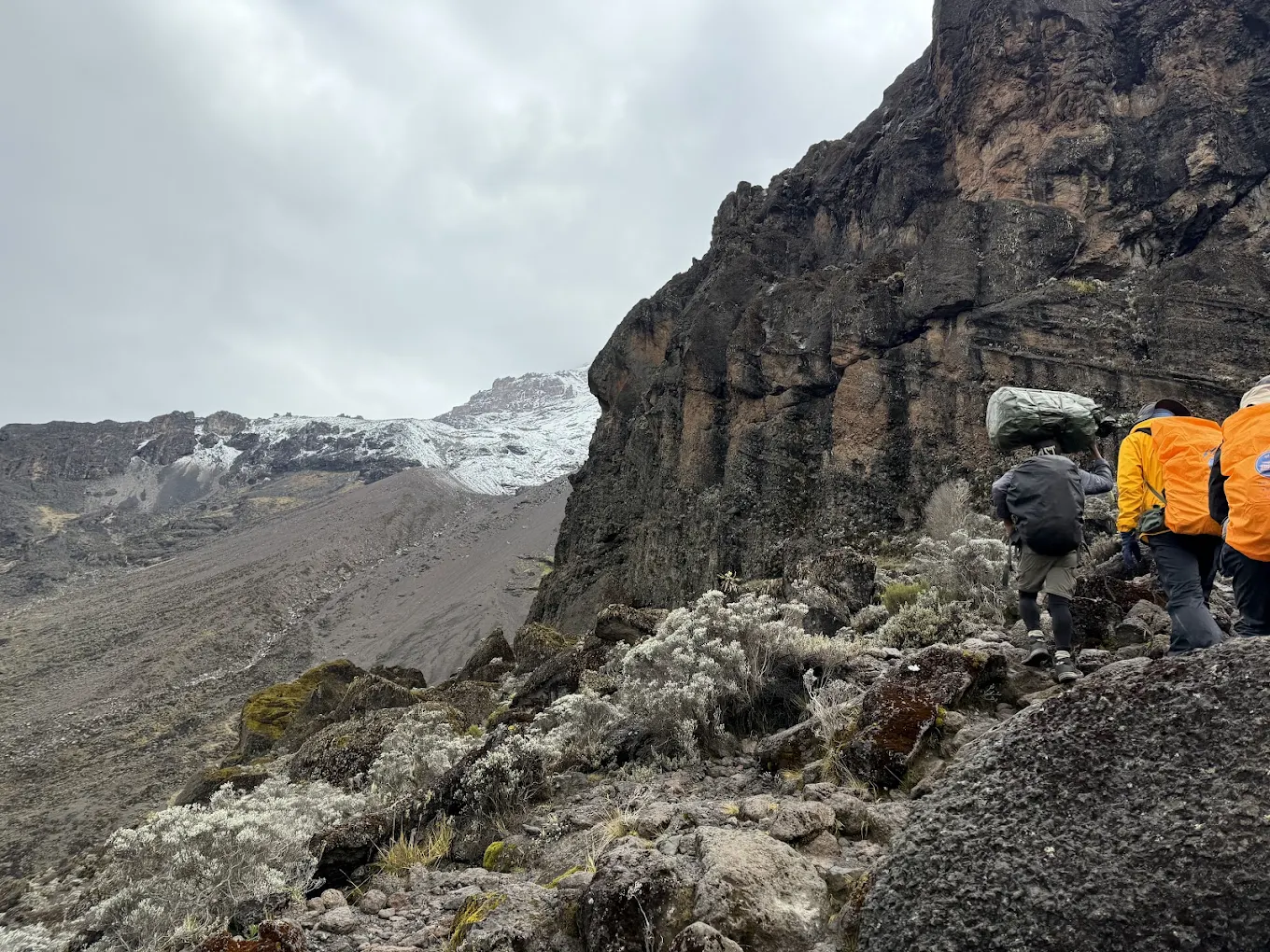
The Barranco Wall on the Machame and Lemosho routes — a 300-metre near-vertical scramble that requires hands and feet but no technical climbing equipment.
Praise has guided all six routes and can walk through the right choice based on your fitness, schedule, and how your body responds to altitude.
The Marangu is the oldest established route on Kilimanjaro and the only one where climbers sleep in permanent wooden huts rather than tents. This gives it a different practical character — no wet sleeping gear, slightly warmer nights, communal dormitory spaces — and makes it marginally more accessible for climbers who are uncomfortable with camping. It is often marketed as the "beginner route" or the "Coca-Cola route," and that framing is misleading in one important respect: it has the lowest summit success rate of all six routes.
The reason is structural. The Marangu uses the same path for both ascent and descent, which means no natural variation in altitude between camps. There are no climb-high, sleep-low days. The standard 5-day itinerary gives the body very little time to acclimatise before the summit push, and the 6-day — which adds an acclimatisation day at Horombo Hut — improves the odds meaningfully. The 6-day Marangu is always recommended over the 5-day.
For experienced high-altitude trekkers who specifically want hut accommodation and are confident in their acclimatisation history, the Marangu is a legitimate option. For climbers whose primary goal is reaching the summit, one of the longer routes with a stronger altitude profile is the more rational choice.
The Northern Circuit is the longest route on Kilimanjaro and, by most measures, the best. It shares the Lemosho approach for the first two days before diverging northward to circumnavigate almost the entire mountain — covering terrain that no other route visits and passing through landscapes that the vast majority of Kilimanjaro climbers never see. It is the least trafficked route on the mountain by a significant margin.
The 9–10 day duration gives the body the most acclimatisation time of any route. The gradual, extended altitude gain — covering the mountain's full northern arc at altitudes between 3,500 and 4,200 metres for several days before the final push — results in summit success rates consistently above 90% with a well-managed operator. For climbers who have previously attempted Kilimanjaro and not summited due to altitude issues, this is the route most likely to change that outcome.
The trade-off is cost and time. The Northern Circuit requires two to three additional days compared to the Lemosho and Machame, which increases park fees, crew costs, and the total investment. For climbers who can accommodate the schedule, it is the most complete experience the mountain offers.
The Umbwe is the most direct and most physically demanding route on Kilimanjaro. It gains altitude faster than any other route on the mountain — climbing steeply through dense rainforest and heath in the first two days, reaching camp altitudes that other routes take three to four days to achieve. This makes it simultaneously the most challenging route for experienced mountain trekkers and the worst choice for summit success due to its compressed acclimatisation time.
The route is genuinely remote and very quiet. Climbers on the Umbwe encounter far fewer other groups than on any southern route, and the steep, rooted forest section in the lower zones is considered among the most atmospheric trail environments on the mountain. It joins the Lemosho and Machame routes on the upper mountain, ascending via the Barranco Valley and summit via Barafu.
Nyange Adventures recommends the Umbwe only to climbers with significant high-altitude experience, a strong prior acclimatisation history, and a specific reason to choose this route over the Lemosho or Machame. For the majority of climbers, the Umbwe's lower success rate and harder physical demands are not a worthwhile trade for its quieter trail and dramatic lower-mountain terrain.
Which Route Is Right for You?
The table above and route descriptions cover the facts. The finder below translates them into a direct recommendation based on the most common climber situations.
A note on "difficulty": every Kilimanjaro route involves multi-day trekking at high altitude. None requires technical climbing skills, ropes, or ice axes for the standard ascent. When operators describe a route as "easy" or "suitable for beginners," this refers to the gradient and trail conditions — not the altitude challenge, which is consistent across all routes. No route is easy above 4,500 metres.
Praise can discuss your fitness, schedule, and altitude history and give a direct recommendation on the right route and itinerary length.
Frequently Asked Questions
What is the easiest route up Kilimanjaro?
No route on Kilimanjaro is easy at altitude. In terms of gradient and trail conditions, the Marangu is the most consistently moderate — it is the only route without steep scrambling sections like the Barranco Wall. However, it also has the lowest summit success rate due to its compressed acclimatisation time. The Lemosho 8-day is the better choice for most first-time climbers: it takes more days but gives the body more time to adapt, which translates directly into a higher chance of standing on the summit.
Which Kilimanjaro route has the highest success rate?
The Northern Circuit consistently achieves summit success rates above 90% with well-managed operators, owing to its 9–10 day duration and exceptional acclimatisation profile. Among the shorter routes, the Lemosho 8-day and Machame 7-day achieve 85–90%+ with experienced guides and appropriate pacing. The Marangu 5-day has the lowest success rate of all routes at approximately 45–55%.
Is the Machame or Lemosho route better?
Both are excellent routes with strong acclimatisation profiles and high success rates. The Lemosho has a slight edge in acclimatisation quality (particularly the 8-day version), is significantly quieter, and covers more diverse terrain including the Shira Plateau. The Machame is more dramatic in its upper sections and marginally shorter. For most first-time climbers, the Lemosho 8-day is the stronger recommendation. For experienced trekkers who specifically want the Barranco Wall scramble and do not mind the busier trail, Machame is excellent.
How many days do I need to climb Kilimanjaro?
A minimum of 7 days on the mountain is recommended for most climbers — 6 days ascending and descending plus an extra acclimatisation day. The 8-day Lemosho and 7-day Machame hit this threshold. Shorter itineraries of 5–6 days are possible but carry a significantly higher risk of altitude sickness and a lower summit success rate. Adding a day almost always improves the outcome. For those who can take 9–10 days, the Northern Circuit offers the best conditions of all.
Do all routes start and end at the same gate?
No. Each route uses different entry and exit gates. Lemosho and Northern Circuit begin at Londorossi Gate on the western side. Machame begins at Machame Gate to the south-west. Marangu begins and ends at Marangu Gate to the south-east. Rongai begins at Rongai Gate near the Kenyan border to the north and descends via Marangu. Umbwe begins at Umbwe Gate to the south. Gate transfers are included in all Nyange Adventures Kilimanjaro packages.
Can I choose where to summit — Stella Point or Uhuru Peak?
Both Stella Point (5,756 m) and Uhuru Peak (5,895 m) are on the crater rim. Stella Point is reached approximately one to two hours before Uhuru Peak on the final ascent, and some climbers who are struggling at that point choose to stop there. KINAPA issues summit certificates for both, though the Uhuru Peak certificate is distinct. The goal for all Nyange Adventures climbers is Uhuru Peak, and the guides will support every climber in getting there if the body allows it.
What is the difference between the 7-day and 8-day Lemosho?
The 8-day Lemosho includes a full rest and acclimatisation day at Shira Camp (3,840 m) before ascending to Lava Tower and descending to Barranco. This single extra day allows the body more time at an intermediate altitude before the high-altitude sections begin. It meaningfully reduces AMS risk and is the recommended option for most climbers, particularly those climbing at altitude for the first time or with any history of altitude sensitivity.
Start Planning Your Kilimanjaro Climb Today
Speak directly with Praise Nyange and our senior safari and Kilimanjaro specialists. We listen carefully, ask the right questions, and design an itinerary that feels unmistakably yours.
No commitment required · Personalised response within 24 hours

Your Safari Specialist
Praise Nyange
Founder & Lead Safari Expert
A decade guiding private safaris across Tanzania's finest parks — every itinerary personally overseen.