Kilimanjaro Rescue Guide 2026: How Evacuation, Costs & Insurance Work
Most Kilimanjaro climbs end exactly as planned: a slow, well-paced ascent, a summit photo at Uhuru Peak, and a walk back down through the forest. But a small number of climbers each year need help getting down — sometimes a guide simply slows the pace and takes them down a few hundred metres, and occasionally a stretcher or helicopter is required. Knowing how that system actually works, before you're on the mountain, removes most of the anxiety around it and ensures you're properly covered if it's ever needed.
This guide explains exactly how rescue and evacuation work on Kilimanjaro: who makes the decision to descend, the methods used at each level of severity, what the mandatory park rescue fee covers (and what it doesn't), and the travel insurance every climber should carry. It is written to inform, not to alarm — the overwhelming majority of climbers never need anything beyond a guide's watchful eye, and the routes and pacing covered in the Kilimanjaro routes guide are themselves the best protection against ever needing the rest of this page.
For the medical side of altitude illness — symptoms, prevention, and how guides monitor for it — see the Kilimanjaro altitude sickness guide. This page focuses specifically on what happens once a descent or evacuation is needed.
Quick answer: every climber pays a mandatory $20 KINAPA rescue fee, which covers ground evacuation — a ranger and stretcher team, on foot, down the mountain. It does not cover helicopter evacuation, hospital treatment, or transport home. For that you need travel insurance that specifically covers high-altitude trekking and emergency evacuation up to 6,000 metres. Helicopters also cannot land above roughly 4,500 metres, so anyone in trouble at a high camp must first be brought down — on foot or by stretcher — before a helicopter can reach them.
How Rescue Works: The Variables That Matter
"Rescue" on Kilimanjaro is not one single thing — it is a graduated system, and which level gets used depends on how serious the situation is, where it happens, and what the weather is doing. The four variables below shape almost every real-world rescue scenario on the mountain.
- Guides check oxygen saturation and pulse twice daily above 3,000 m
- Symptoms are scored against a standard AMS checklist
- The guide — not the climber — makes the final call to descend
- Reporting symptoms early is the single biggest factor in a safe outcome
- Four methods exist: walking descent, stretcher, vehicle, helicopter
- The method is chosen by severity, location, and weather — not by request
- Most "rescues" never go beyond a guide-assisted walk-down
- Helicopter evacuation is the last resort, not the first option
- A mandatory $20 KINAPA rescue fee is charged to every climber
- It covers ground evacuation only — stretcher, ranger, and crew time
- It does not cover helicopter flights, hospital bills, or repatriation
- Travel insurance with high-altitude evacuation cover is essential
- Vehicle-accessible gates (Mweka, Marangu, Londorossi) speed up ground transfer
- Remote routes like the Northern Circuit and Umbwe take longer to reach
- High camps above the helicopter ceiling always need a ground descent first
- A well-acclimatised route is the best way to reduce the chance of needing any of this
At a Glance: Evacuation Methods Compared
| Method | Used For | Speed | Altitude Limit | Covered by Park Fee |
|---|---|---|---|---|
| Guide-managed descent | Mild AMS, fatigue | Hours | Any altitude | Yes |
| Stretcher ("Kilimobile") | Moderate AMS, injury, exhaustion | Several hours | Any altitude (ground) | Yes |
| Vehicle / gate transfer | Getting to hospital from a gate | Under 1 hour | Below ~1,800–2,000 m | Yes |
| Helicopter evacuation | Severe AMS/HACE/HAPE, serious injury | 1–2 hrs, weather permitting | Max ~4,500 m | No — insurance only |
The Rescue System in Full
The vast majority of "rescues" on Kilimanjaro never involve a stretcher, a vehicle, or a helicopter — they involve a guide noticing early signs of altitude trouble and simply changing the plan. A headache, mild nausea, or unusual fatigue is assessed against a standard symptom checklist and an oxygen saturation reading, and if the guide is concerned, the response is almost always the same: slow down, descend a few hundred metres to the next lower camp, and reassess.
This works because Kilimanjaro's altitude illness is, in the great majority of cases, directly responsive to descent. Moving even 300–500 metres lower is often enough to resolve mild symptoms within hours. This is also why route choice matters so much before you ever set foot on the mountain — a route with a stronger acclimatisation profile, like the Lemosho or Northern Circuit, gives the body more buffer and makes this kind of early intervention far less likely to be needed in the first place.
The single most important thing a climber can do here is be honest. Guides are trained to spot symptoms, but climbers who push through a headache without mentioning it remove the window in which this simplest, safest form of "rescue" still works.
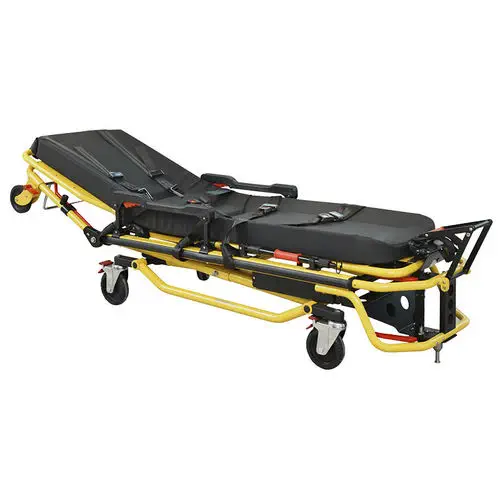
When a climber can no longer walk under their own power — whether from worsening altitude illness, an injury, or sheer exhaustion — but is not in immediate life-threatening danger, the standard response is a stretcher evacuation. Kilimanjaro's crews use a locally built single-wheel stretcher, known on the mountain as the "kilimobile," which a team of four to six porters push and pull down the trail.
It is slow and physically demanding for everyone involved — the terrain on most routes is rooted, rocky, or steep in sections — but it works at any altitude and on any route, which makes it the backbone of the entire rescue system. As soon as a stretcher evacuation begins, the lead guide radios park rangers, who track the descent and, where needed, send additional crew to assist.
This method is included in the mandatory park rescue fee every climber already pays. There is no additional charge for the stretcher itself, the porters' time, or the ranger coordination — though it does not cover any hospital treatment once the climber reaches the bottom.
A walking or stretcher descent has one practical destination: a gate that a vehicle can reach. Mweka, Marangu, and Londorossi all sit at the end of a vehicle track, and once a climber arrives at one of these points, the rest of the journey to a hospital in Moshi or Arusha is fast — usually under an hour on reasonable roads.
This is where route choice has a genuine, if secondary, effect on rescue speed. Routes that exit through Mweka or Marangu reach a vehicle as soon as the gate is reached. The Northern Circuit and Umbwe, by contrast, are more remote for longer, simply because of where their trails run — which is one more reason Nyange Adventures only recommends those routes to climbers with solid altitude experience.
This stage is included in the standard park rescue arrangement; what happens after arrival — hospital admission, treatment, and any further transfer — is where travel insurance becomes the deciding factor in cost.
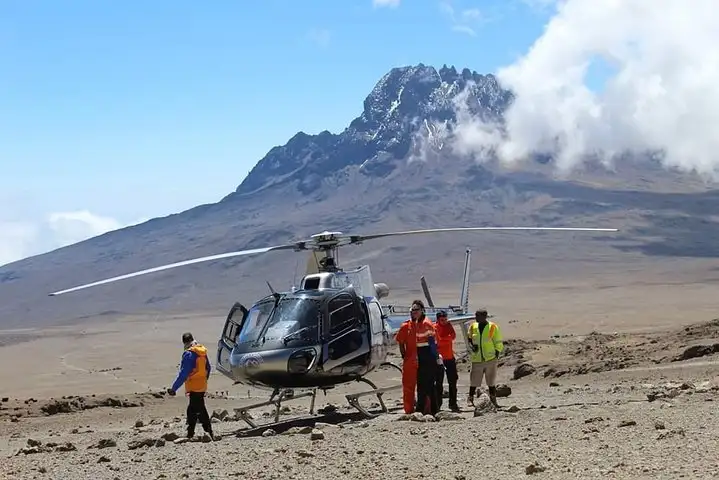
Helicopter evacuation is reserved for severe cases and is weather- and altitude-dependent — it cannot reach the upper mountain.
Praise can walk you through Nyange Adventures' safety protocol, what's included in your package, and exactly what your travel insurance needs to cover before you book.
Helicopter evacuation is reserved for the most serious situations: suspected HACE or HAPE, severe injury, or any symptom that is judged life-threatening if descent takes too long on foot. It is not a faster alternative to a stretcher for moderate cases — it is a separate tier of response, used when time genuinely cannot be spared.
Two hard limits shape every helicopter rescue on Kilimanjaro. First, helicopters cannot land above roughly 4,500 metres because of thin air and rotor performance — which means anyone above that altitude must first be brought down by stretcher or on foot before a helicopter can reach them at all. Second, flights depend entirely on weather: cloud cover, wind, and rain — especially common in the afternoon — frequently ground aircraft, even in genuine emergencies.
When conditions allow, a helicopter dispatched from Moshi can typically reach an accessible pickup point within one to two hours. Coordination happens directly between your guide, your tour operator, and a private aviation provider — this is not part of the government park system, which is why it is not covered by the $20 KINAPA rescue fee. Cost is paid through, or reimbursed by, travel insurance that specifically covers helicopter evacuation; without it, the cost falls on the climber directly.
Travel Insurance: What You Actually Need
The $20 KINAPA rescue fee is mandatory and important, but it is easy to mistake it for full coverage — it isn't. It pays for ground evacuation only. Everything beyond that — a helicopter flight, hospital admission, treatment, and getting you home if you can't fly commercially — depends entirely on the travel insurance policy you bought before the trip. Before booking, confirm your policy includes:
- High-altitude trekking cover — specifically rated for trekking up to at least 6,000 metres, not a standard travel policy
- Emergency medical evacuation, including helicopter evacuation by name — some policies exclude air evacuation unless stated explicitly
- Hospital treatment in Tanzania, and onward repatriation if a more serious condition requires transfer to a larger facility
- Trip cancellation and interruption, in case illness or injury cuts the climb short before summit
Specialist providers with mountaineering and high-altitude experience — rather than generic travel insurers — are generally the safer choice for this kind of cover. Nyange Adventures can review your policy wording with you before your climb if you're unsure whether it meets these requirements.
Which Routes Are Easiest to Evacuate From?
Every route on Kilimanjaro has the same rescue system available to it, but accessibility varies. Routes that exit through Mweka or Marangu reach a vehicle track as soon as the gate is reached, which shortens the final leg to hospital. The Northern Circuit and Umbwe are more remote by design — part of what makes them quieter and more scenic also makes the ground-transfer stage slower if it's ever needed.
This is a secondary factor, though, and shouldn't be the main driver of route choice. A route's acclimatisation profile has a far bigger effect on whether a climber ever needs evacuating in the first place than its proximity to a gate does once something has gone wrong. The full breakdown of acclimatisation, scenery, and difficulty by route is covered in the Kilimanjaro routes guide.
A note on prevention: the rescue system exists because climbing to 5,895 metres carries real risk — but the great majority of serious incidents on Kilimanjaro are altitude-related and preventable. Choosing an itinerary with enough acclimatisation days, letting your guide check your oxygen levels twice daily, and reporting symptoms the moment they appear prevent the overwhelming majority of situations that would otherwise require any of the above. No insurance policy is a substitute for proper pacing.
Praise can talk through your medical history, insurance options, and what Nyange Adventures' guides carry on every climb.
Frequently Asked Questions
What happens if I get altitude sickness on Kilimanjaro?
Your guide checks your symptoms against a standard checklist and your oxygen saturation with a pulse oximeter, typically twice a day above 3,000 metres. Mild cases are managed with rest, fluids, and a short descent to a lower camp. If symptoms worsen or don't respond to descent, the guide escalates to a stretcher evacuation and, in severe cases, requests a helicopter if altitude and weather allow it.
Does the Kilimanjaro park fee cover helicopter rescue?
No. The mandatory $20 KINAPA rescue fee covers ground evacuation only — a ranger and stretcher team on foot. Helicopter evacuation is arranged separately through private aviation providers and is not part of the government park system, so it is not included in any park fee. It is paid through, or reimbursed by, travel insurance that specifically covers helicopter evacuation.
How much does a Kilimanjaro helicopter evacuation cost?
Costs vary by provider and pickup location, but typically range from roughly $2,000 to $10,000. This is paid upfront or billed directly in many cases, which is why travel insurance with explicit helicopter evacuation cover is essential rather than optional. Without it, the full cost falls on the climber.
What travel insurance do I need for Kilimanjaro?
Look for a policy that explicitly covers high-altitude trekking up to at least 6,000 metres, names helicopter evacuation as covered (not just "emergency evacuation" in general terms), and includes hospital treatment and repatriation. Specialist mountaineering insurers tend to handle Kilimanjaro claims more reliably than generic travel policies.
Which Kilimanjaro routes are easiest to evacuate from?
Routes exiting through Mweka or Marangu reach a vehicle-accessible gate quickly, which speeds up the final transfer to hospital. The Northern Circuit and Umbwe are more remote and take longer to reach by ground. That said, a route's acclimatisation quality matters far more to your overall safety than its proximity to a gate — see the Kilimanjaro routes guide for the full comparison.
Can I be evacuated from the summit?
Not by helicopter — Uhuru Peak, at 5,895 metres, is far above the roughly 4,500-metre ceiling for helicopter landings. Anyone needing evacuation from the summit area or summit night camps must first descend on foot or by stretcher to a lower altitude before any aircraft can reach them. This is one of the reasons guides are conservative about allowing a climber to continue if early symptoms appear.
Is Kilimanjaro dangerous?
Kilimanjaro is climbed safely by the large majority of the many thousands of people who attempt it each year. The main risks are altitude-related rather than technical — none of the standard routes require ropes or climbing equipment — and the biggest single factor in a safe outcome is choosing an itinerary with enough acclimatisation days and being honest with your guide about symptoms as soon as they appear.
Start Planning Your Kilimanjaro trip Today
Speak directly with Praise Nyange and our senior safari and Kilimanjaro specialists. We listen carefully, ask the right questions, and design an itinerary that feels unmistakably yours.
No commitment required · Personalised response within 24 hours

Your Safari Specialist
Praise Nyange
Founder & Lead Safari Expert
A decade guiding private safaris across Tanzania's finest parks — every itinerary personally overseen.