Best Time to Visit Tanzania: A Month-by-Month Guide to Safari Seasons, Migration & Weather
"What's the best time to visit Tanzania?" is probably the question we hear more than any other at Nyange Adventures — usually before budget comes up, before anyone's picked a route, sometimes even before we've exchanged names. Fair enough, really. Get the timing wrong and you can end up bumping down a half-flooded track in Tarangire wondering why nobody warned you, or paying peak-season rates for a month that didn't actually need them.
Here's the honest version: there's no single best month, there's a best month for what you're chasing. Someone who wants the Mara River crossings wants July through September. Someone after newborn wildebeest calves and a quieter, cheaper trip wants late January into February. Someone who just wants two reliably dry weeks in the bush followed by a few lazy days in Zanzibar is working off a slightly different calendar again. This guide walks through all of it, month by month, more or less the way our team would talk you through it on a call from our office in Moshi.
If you already know roughly when you're travelling and want to look at the parks themselves, our Tanzania safari tours page is a good next stop. Combining the bush with a beach? Have a look at our safari and Zanzibar itineraries, and once your dates are set, our packing list guide will save you some second-guessing.
Quick answer: if you only take one thing from this page — June to October is Tanzania's long dry season and the safest bet for a first safari: firm roads, easy wildlife viewing, and the Great Migration moving through the northern Serengeti and across the Mara River. January and February run a close second, especially if seeing the wildebeest calving season matters more to you than river drama. Everything below is the detail behind that one paragraph.
When to Go for What You Actually Want to See
Before the month-by-month breakdown, here's the shortcut. Match your priority to the season that actually delivers it, rather than just defaulting to "whenever works."
- June to October
- Most reliable game viewing of the year
- Best window for first-time safari-goers
- Busiest and most expensive months
- November to May (split by short dry spell)
- Lush landscapes, dramatic skies, fewer vehicles
- Best rates of the year, especially March–May
- Some southern-circuit camps close in April
- Late January into February
- Over 500,000 wildebeest calves born in weeks
- Centred on Ndutu & the southern Serengeti
- Intense predator-prey action, fewer crowds than July
- July to September (peaks August–September)
- Herds gather in the northern Serengeti
- The single most-requested safari sighting
- Book lodges 6–12 months ahead for this window
- Best: June–October & late December–February
- Clearer skies, drier trails, better summit odds
- Avoid March–May (long rains on the mountain)
- Pairs naturally with a northern-circuit safari
- Best: June–October & December–February
- Avoid: April–early May (heaviest coastal rain)
- Whale sharks at Mafia Island October–March
- Pairs well straight after a northern safari
Tell us your rough dates and we'll tell you straight whether they work.
Tanzania's Two Big Seasons: Dry vs Wet
Strip away the marketing language and Tanzania really only has two seasons that matter for planning purposes: dry and wet. Everything else — calving, crossings, shoulder months — sits inside that bigger pattern.
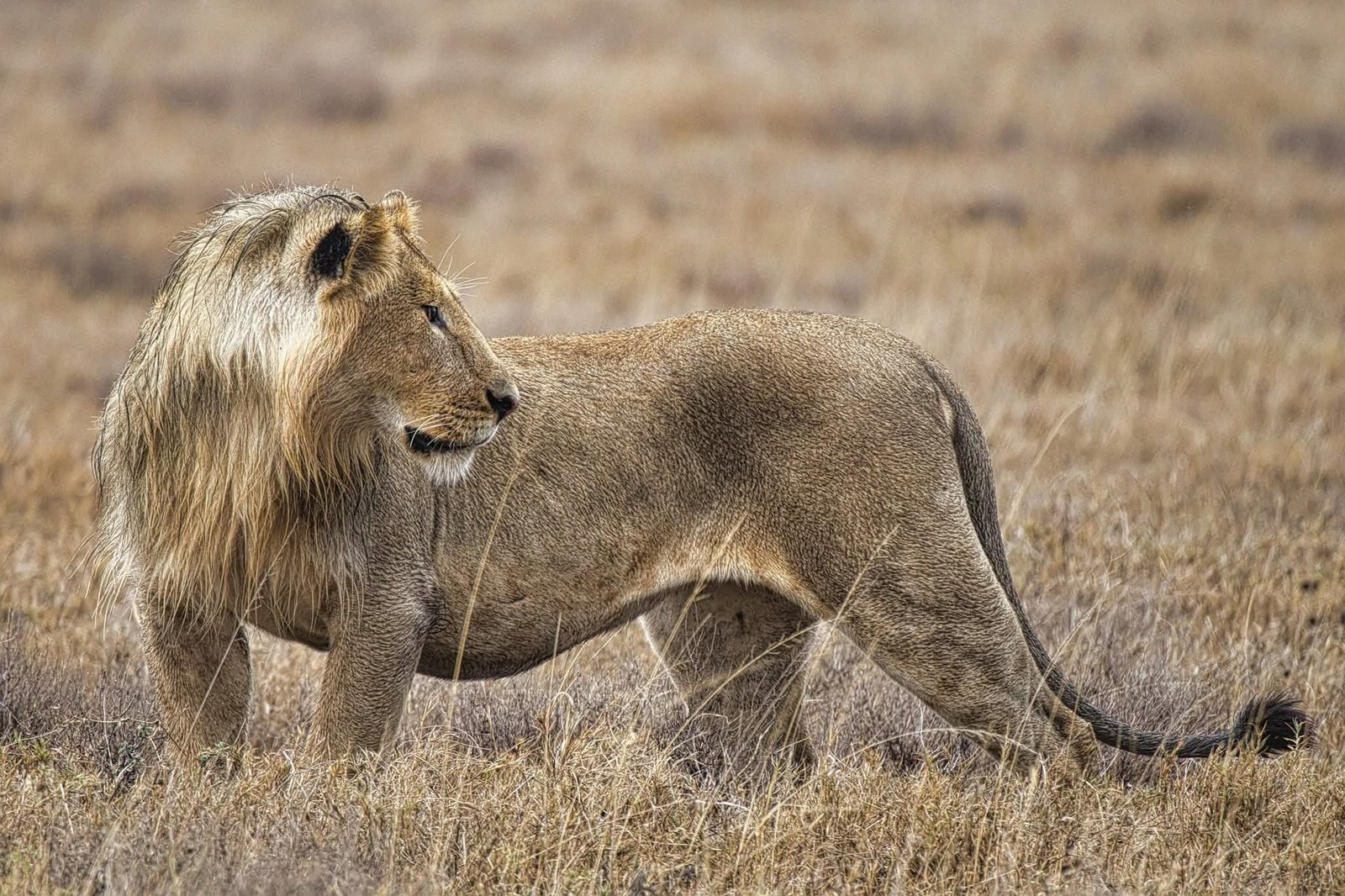
Dry-season tracks are firm, dusty, and easy going — exactly what most first-time safari guests picture.
The dry season runs roughly June through October. Skies stay clear for weeks at a time, vegetation thins out, and animals cluster around the rivers and waterholes that haven't dried up — which, conveniently, is exactly where your vehicle will be parked. Mornings can be properly cold, especially on the Ngorongoro Crater rim, so don't let "dry season" fool you into leaving the fleece at home.
The wet season splits into two: the short rains from around mid-November to December, usually a burst of afternoon thunder that clears by evening, and the long rains from March through May, which are heavier, more sustained, and the main reason some southern-circuit camps shut their doors for a few weeks. Tanzania sits close to the equator, so even "rainy season" rarely means grey skies all day — more a pattern of bright mornings and dramatic afternoon storms that pass quickly.
Month-by-Month: What Tanzania's Weather Actually Does
Averages only tell you so much, and a few of our guides will tell you the seasons have been shifting earlier or later by a couple of weeks most years lately — nature doesn't read brochures. Still, this is the pattern that's held for the long stretch, and it's the one we plan around.
| Month | What's Happening | Season |
|---|---|---|
| January | Hot, mostly dry with the odd afternoon shower. Calving begins in Ndutu and the southern Serengeti. Good month for a quieter, less crowded safari. | Shoulder |
| February | Driest stretch of the early year. Calving peaks, predator action is intense, and Kilimanjaro climbing conditions are excellent. | Shoulder |
| March | The long rains begin in earnest. Landscapes turn vivid green, parks empty out, and prices drop noticeably. | Low |
| April | Heaviest rainfall of the year. Several southern and western-circuit camps close for maintenance. The Serengeti and Ngorongoro stay open and quiet. | Low |
| May | Rain eases off by mid-month. The migration pushes into the western corridor toward the Grumeti River. Excellent value, still very quiet. | Low |
| June | Dry season opens. Cooler mornings, clearer skies, herds moving north through the central Serengeti. Kilimanjaro climbing season begins. | High |
| July | Arguably the most complete month for a first safari — dry, cool, and the first Mara River crossings usually begin. | High |
| August | Driest, busiest month of the year. Dramatic crossings continue in the northern Serengeti. Zanzibar's beaches are lively. | High |
| September | Still reliably dry, herds remain in the north, and crowds thin slightly compared with July–August. A favourite among our repeat guests. | High |
| October | Last of the long dry spell. Herds start drifting south again. Short rains usually arrive in the final week. | Shoulder |
| November | Short rains begin — brief afternoon downpours rather than all-day grey. Migration herds head south, landscapes green up fast, and rates drop. | Shoulder |
| December | Showers taper off by mid-month. Warm, mostly dry, and busy over Christmas and New Year despite technically sitting in the wet season. | Shoulder |
The Great Migration Calendar
It's worth saying clearly: the wildebeest migration is not an event with a start and end date, it's a continuous loop of well over a million animals circling the Serengeti-Mara ecosystem all year. There's no single month it "happens" — but there are months where the spectacle is more concentrated and easier to position yourself for.
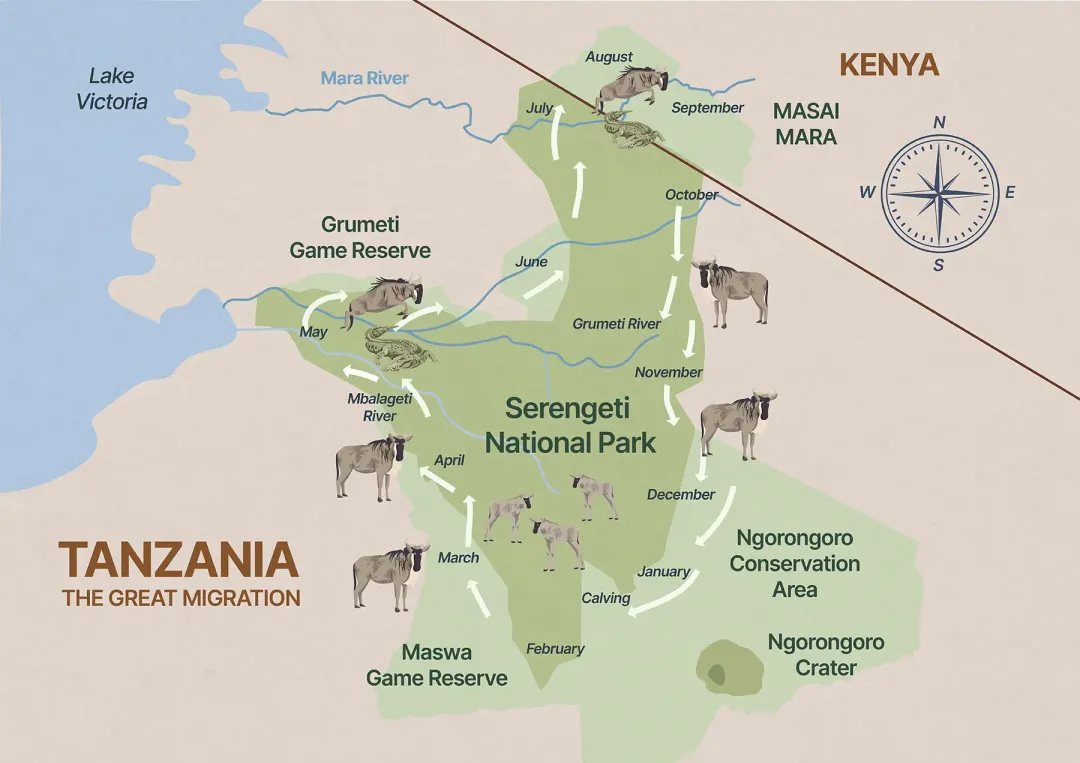
Where the herds go, the predators follow — lions, hyenas and cheetahs all time their hunting to the migration.
- December–March: Herds spread across the southern Serengeti and Ndutu, with calving concentrated in late January and February.
- April–May: Herds move north-west through central Serengeti into the western corridor, with early Grumeti River crossings.
- June–July: The migration pushes further north, building toward the Serengeti's famous river system.
- July–October: Peak season for the northern Serengeti and the dramatic Mara River crossings most people picture when they hear "wildebeest migration."
- November: Herds turn south again, completing the loop before calving season restarts.
If watching a crossing is non-negotiable for you, build real flexibility into your itinerary — nature doesn't run on a fixed schedule, and the herds can sit on one riverbank for days before committing. Our wildebeest migration safari itineraries are built with that flexibility in mind, with extra nights positioned where the action is most likely to be.
Northern Circuit vs Southern & Western Circuit: Timing Matters Differently
This is the part that catches a lot of first-time planners out. Not every part of Tanzania runs on the same calendar.
The northern circuit — Serengeti, Ngorongoro Crater, Tarangire, Lake Manyara — is genuinely good year-round. Even in the rains, the Crater holds wildlife densely enough that visibility barely suffers, and the green-season light is honestly some of the best for photography all year.
The southern and western circuits — Ruaha, Nyerere, Katavi — feel the seasons far more directly. Roads soften, some lodges close for weeks at a time during the heaviest rains, and the dry months from June to October are less a preference and more a practical requirement for getting around comfortably. If a southern-circuit park is on your list, treat the dry season as close to essential.
Mixing circuits on one trip? A private, fully tailored itinerary gives you the most room to chase the right season for each park without compromising on either. Our private luxury safari packages are built exactly this way, route and pace shaped around your travel dates rather than a fixed group schedule.
Best Time to Climb Kilimanjaro Alongside Your Safari
If Mount Kilimanjaro is part of the plan — and for a lot of our guests it is, since it sits right on our doorstep here in Moshi — the climbing calendar tracks the same dry-season logic as the safari does, with one extra sweet spot. The clearest, driest trekking windows are June through October and the short dry stretch from late December into February, when skies are sharpest and summit views are at their best. March through May is the one period we'd actively steer most climbers away from, since the long rains make the upper slopes cold, slippery, and far less rewarding for the effort involved.
For the full month-by-month breakdown of conditions on the mountain itself, our dedicated best time to climb Kilimanjaro guide goes much deeper, and our Kilimanjaro packing list covers what to bring beyond standard safari gear. Quite a few of our guests combine both in a single trip — our safari and Kilimanjaro climb itineraries are built specifically around that pairing.
Best Time for Zanzibar After Your Safari
A lot of our itineraries end the same way: a few days of decompression on Zanzibar after a week or two of early game-drive starts. The island runs warm year-round, but it's not immune to the rains either.

The same dry-season light that makes a Serengeti sunset so good travels straight through to Zanzibar's beaches.
June through October and December through February are Zanzibar's best beach months — warm, dry, and calm enough for diving and snorkelling around Mnemba and the Mafia Island archipelago. April and early May bring the heaviest coastal rain, and several beach resorts close briefly or drop rates significantly during that window. If whale sharks are on your list, October through March is the window for Mafia Island. Our safari and Zanzibar beach combinations are timed to land you on the island during the better-weather months wherever your schedule allows.
Tell us what you most want to see and we'll tell you honestly which month gives you the best shot at it.
Peak, Shoulder & Green Season — What It Means for Your Wallet
Crowds and prices follow the weather pretty predictably:
- Peak season (July–September, and Christmas through early January): Highest lodge rates, busiest parks, and the months that sell out furthest in advance. Book 6–12 months ahead if these dates are fixed for you.
- Shoulder season (January–February, June, October–November): A genuinely good balance — solid weather most days, noticeably fewer vehicles at the better sightings, and rates that sit comfortably below peak.
- Green season (March–May): The best value of the year by a clear margin, and a favourite among photographers for the light and the lush scenery. The trade-off is a real chance of rain interrupting a game drive and a handful of southern-circuit camps closing in April.
Budget tip: if the Mara River crossing isn't the deciding factor for you, late November or early December can quietly be one of the smartest windows of the year — the same northern parks at a fraction of peak-season cost, with short afternoon showers that rarely cancel a game drive outright.
Our Honest Recommendation
If you put us on the spot and you've never done a Tanzania safari before, July or September are hard to beat — reliable weather, a strong chance at the Mara crossings, and slightly less elbow-to-elbow than the absolute peak of August. If keeping costs sensible matters more to you than bragging rights about a river crossing, we'll usually point you, quietly, toward late November instead. Same parks, same Big Five, a fraction of the price.
And if you ask a few of our own guides what their personal favourite month is, more than one will say February — not for the weather, which is good but unremarkable, but for the calving season in Ndutu. Watching newborn wildebeest find their feet for the first time, with predators waiting at every turn, is the kind of morning that sticks with people longer than a river crossing does.
Frequently Asked Questions
What is the single best month to visit Tanzania for a safari?
Most safari specialists, ourselves included, point to July or September. Both sit firmly in the dry season, both offer a strong chance at the Mara River crossings, and September is slightly quieter than the August peak. August itself is the busiest and most dramatic month if crowds don't bother you.
When exactly does the wildebeest migration cross the Mara River?
Most years it runs from July through September, sometimes stretching into early October, as the herds reach the northern Serengeti. It's driven by rainfall and grass growth rather than a fixed calendar, so exact timing shifts year to year — flexibility in your itinerary helps a lot here.
Is it worth visiting Tanzania during the rainy season?
Yes, more than people expect, particularly on the northern circuit. Ngorongoro Crater and central Serengeti stay productive year-round, the landscapes turn a deep green that photographs beautifully, and rates drop noticeably. The southern and western circuits are more affected, with some camps closing briefly in April.
What is the cheapest time of year to visit Tanzania?
March through May, known locally as the green season, consistently offers the lowest lodge rates of the year. April is the wettest month and the one where you're most likely to encounter a closed camp on the southern circuit, so May is often the sweet spot for value without quite as much rain.
Can I combine a Tanzania safari with a Zanzibar beach holiday on the same trip?
Very easily, and most of our guests do exactly that. A short flight connects Arusha or the Serengeti to Zanzibar, so a typical pattern is a week of safari followed by four or five days on the beach. Aim for June–October or December–February for the best weather on both legs of the trip.
Is Ngorongoro Crater good to visit year-round?
Yes — it's one of the most reliable wildlife destinations in Tanzania regardless of season, thanks to the high density of animals living within the crater floor. The main seasonal difference is cosmetic: lush and green in the rains, dustier and golden in the dry months.
How far in advance should I book for peak season?
For July, August, September, or the Christmas and New Year period, six to twelve months ahead is sensible, particularly for popular northern Serengeti camps near the migration route. Shoulder and green season months are far more forgiving and can often be booked just a few months out.
Start Planning Your Tanzania Safari Today
Speak directly with Praise Nyange and our senior safari and Kilimanjaro specialists. We listen carefully, ask the right questions, and design an itinerary that feels unmistakably yours.
No commitment required · Personalised response within 24 hours

Your Safari Specialist
Praise Nyange
Founder & Lead Safari Expert
A decade guiding private safaris across Tanzania's finest parks — every itinerary personally overseen.