

Moshi sits at the foot of Mount Kilimanjaro, and it is where our office is. Most people know the town as the base for Kilimanjaro climbs, but it also works well as the starting point for a safari on Tanzania's northern circuit, either on its own or before or after a climb.
From Moshi we arrange safaris to Tarangire National Park, Lake Manyara National Park, the Ngorongoro Conservation Area and Serengeti National Park, as well as to quieter parks in the Kilimanjaro region. This guide explains how the distances work from Moshi, which parks suit short and long trips, and how to fit a safari around your climb.
Why start your safari in Moshi
The biggest advantage is convenience if Kilimanjaro is already part of your plans. Instead of transferring to another town after coming down the mountain, you can rest in Moshi and set off for the parks from there. The same works in reverse if you would rather do the safari first.
A common pattern is to finish the climb, spend a night recovering in Moshi and leave on safari the next morning. It cuts out unnecessary transfers and keeps the whole trip simple to organise.
Many travellers also like Moshi as a quieter base before or after their safari. The town has accommodation and services suited to people getting ready for the mountain or the parks.
Getting to Moshi
Moshi is relatively close to Kilimanjaro International Airport (JRO), the main gateway for northern Tanzania, which makes it practical for both arrival and departure. Airport transfers can be built into your itinerary; confirm the exact pickup and drop-off arrangements before you travel.
Leave enough time between your international flight and the start of the safari. Flights can be delayed, and a tight connection adds stress you do not need.
How the distances work from Moshi
Moshi is not as central to the northern circuit as Arusha, so the drive to the Serengeti and the Ngorongoro Crater is longer. That does not rule them out. It simply means the number of safari days matters more.
On a short trip, several hours of driving to and from a distant park leaves less time for game drives. On a five- to seven-day itinerary the extra distance is easy to absorb, because you spend several nights in the main safari areas.
Safari parks to consider from Moshi
Tarangire National Park
Tarangire is one of the best choices for a safari from Moshi, particularly when time is short, because it avoids the much longer journey to the central Serengeti. It is known for its elephants and baobab landscapes, which feel quite different from the Serengeti plains.
Wildlife here changes with the seasons, especially with the availability of water and grazing. When animals concentrate, game drives can bring elephants, zebras, wildebeest, buffalo, giraffes, lions and plenty of birdlife. Tarangire can be the whole of a short safari or the first stop on a longer circuit.
Ngorongoro Crater
The Ngorongoro Crater, in the Ngorongoro Conservation Area, combines a dramatic volcanic landscape with a concentrated wildlife population, which makes it a good choice when you want as much game viewing as possible in limited time. The surrounding highlands are a striking change of scenery from the open plains. The crater pairs well with Tarangire, or with the Serengeti on a longer trip.
Serengeti National Park
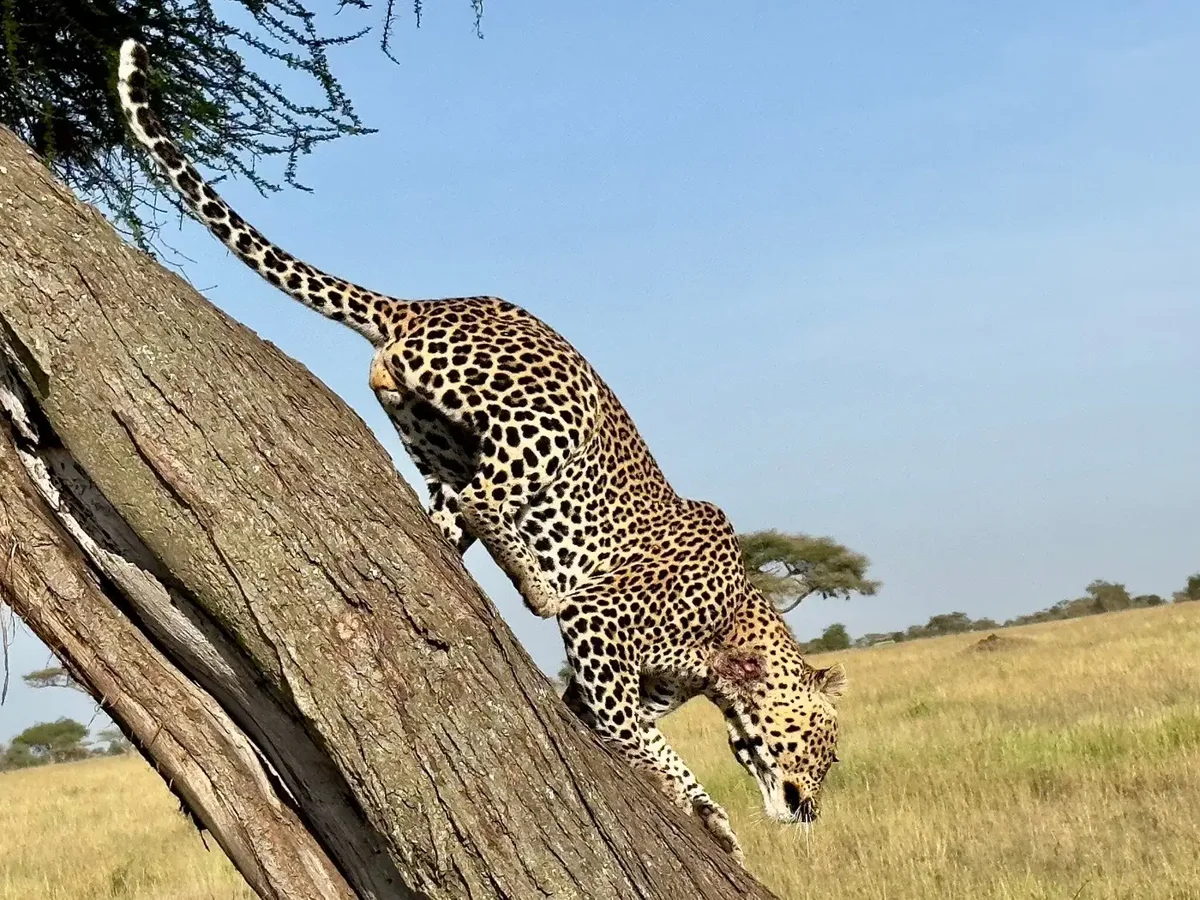
The Serengeti is usually the main draw on a longer safari from Moshi, with its vast plains, varied wildlife and the Great Migration. Lions, elephants, zebras, wildebeest, giraffes, cheetahs and leopards all live here. The park covers a huge area, so allow several days rather than a rushed visit.
The herds move through the Serengeti ecosystem all year in response to rain and grazing. If the migration is your priority, plan your route around where the herds are expected to be on your dates.
Lake Manyara National Park
Lake Manyara combines lake shore, forest, wetland and open country. It adds variety to a northern circuit when you have time to include an extra park.
Mkomazi National Park
Mkomazi National Park is especially relevant if you are starting in Moshi, because it lies in the wider Kilimanjaro region. It offers a different and generally quieter safari than the main northern circuit parks, either as an alternative or as an addition. Our 12-Day Tanzania Safari | Mkomazi, Natron & Ndutu includes it on a longer route.
Arusha National Park
Arusha National Park is another option for a short trip. Weigh up whether the time it takes is worthwhile compared with spending more days in one of the major wildlife areas.
Matching the trip length to the route
The most important planning decision is how many days you have. Avoid an itinerary that spends most of your holiday driving between parks.
- Two days: a short introduction to wildlife. Tarangire or another accessible park is more realistic than trying to reach the central Serengeti.
- Three days: the Serengeti and Ngorongoro are possible, but expect long days on the road from Moshi.
- Four days: a better balance between driving and game drives, for example Tarangire, the Serengeti and Ngorongoro.
- Five to seven days: room for Tarangire, Ngorongoro, the Serengeti and possibly Lake Manyara, with more than one night in your chosen areas.
Rather than trying to see every famous park, choose a manageable number and give each one enough time. Short trips suit the nearer parks; longer safaris justify the extra driving to the Serengeti.
Combining a safari with your Kilimanjaro climb
If you are climbing Kilimanjaro, build in a recovery night between the mountain and the safari. A climb is physically demanding, and setting off on a long drive as soon as you get back to Moshi is not the safest option.
A practical plan is to arrive in Moshi, spend several days on the mountain, rest for a night and then head out on safari. Our 7-Day Machame Route Kilimanjaro Climb + 3-Day Safari and 5-Day Marangu Route Climb and 4-Day Tanzania Wildlife Safari both follow this pattern. You can also do the safari first and climb afterwards; the better order depends on how you feel physically and on your flight times.
Our Kilimanjaro climb packages include a night in Moshi before and after the climb, so continuing to the parks from town is straightforward.
Pack separately for the two parts of the trip. On safari you need lightweight clothing, comfortable shoes, sun protection, insect repellent, binoculars and a camera. On the mountain, conditions at high altitude are very different and temperatures far lower.
Moshi also fits a safari-and-Zanzibar trip. After the northern circuit, a domestic flight takes you to Zanzibar for a few nights on the coast.
Choosing the style of safari
Safaris from Moshi are available at every level, from shared camping trips and budget lodges to mid-range, private and luxury itineraries.
- Shared safaris: sharing the vehicle spreads the cost of the guide, driver and transport. If camping is included, check what kind it is, what equipment is provided and whether meals and park fees are covered.
- Mid-range safaris: lodges or permanent tented camps, with a standard safari vehicle and a professional guide.
- Private safaris: your own vehicle and schedule, more time at sightings and a pace that suits you. This works well for families who need breaks, photographers who want to wait for the right moment and couples who value privacy.
- Luxury safaris: premium lodges or tented camps, a private vehicle, upgraded meals and sometimes domestic flights, usually with more time in fewer, carefully chosen places.
When comparing prices, look past the headline figure. A package should state clearly whether it covers park and conservation fees, accommodation, meals, transport, guiding and airport transfers, whether the safari is private or shared, and how many people will be in the vehicle.
On long drives from Moshi the vehicle makes a real difference. Comfortable seating, good visibility, a pop-up roof, luggage space and charging points all help. If your trip includes a domestic flight, check the airline's baggage rules and ask us whether soft-sided bags are recommended.
Frequently asked questions
Is Moshi or Arusha better for starting a safari?
Arusha is closer to the main parks, so the drives are shorter. Moshi makes most sense if you are also climbing Kilimanjaro or want a quieter base near the airport, and on a longer safari the extra distance matters much less.
How long should a safari from Moshi be?
Two days focused on Tarangire works as a short introduction. Four days gives a better balance between driving and game viewing, and five to seven days lets you include the Serengeti without rushing.
Can I go on safari straight after climbing Kilimanjaro?
We recommend at least one night of rest in Moshi first. You can then set off for the parks the following morning.
To start planning, tell us your dates, how many days you have for the safari and whether Kilimanjaro is part of the trip. Our team in Moshi will suggest a route that keeps the driving sensible and leaves you plenty of time with the wildlife.